

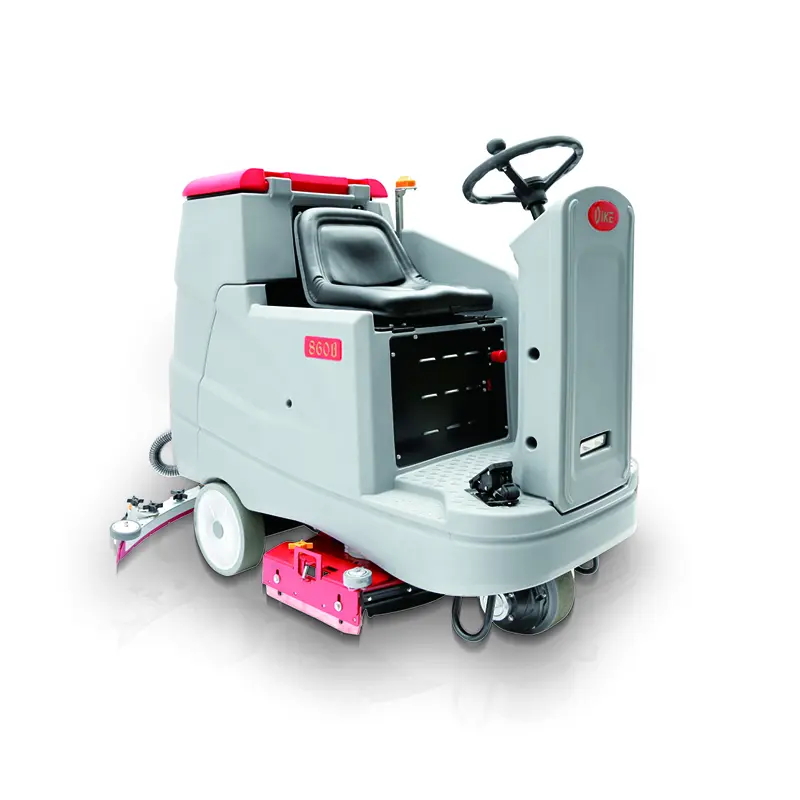
A ride-on floor scrubber cleans hard floors in one continuous pass—laying down solution, scrubbing with rotating brushes, and vacuuming dirty water back into a recovery tank. Compared to walk-behind models, it covers more square meters per shift, keeps the operator off their feet, and shortens the cleaning window in large facilities where closing aisles
How the Scrubbing System Works in Practice
A ride-on floor scrubber runs a straightforward cycle built for shift-after-shift reliability. The solution tank holds water mixed with low-concentration detergent, fed by gravity or pump to the scrub deck. Disc brushes suit smooth floors; cylindrical brushes handle textured surfaces, grouted tile, and loose debris by sweeping material into a hopper while scrubbing.
Behind the brushes, a curved polyurethane or rubber squeegee collects the dirty solution. A vacuum motor pulls the slurry through the squeegee and into a separate recovery tank. The floor stays nearly dry right after the pass, so areas reopen faster than with mopping. Some models let the operator adjust down pressure, solution flow, and brush speed to match the soil level without wasting water or chemical.
Where Ride-On Scrubbers Fit into Facility Operations
The jump from a walk-behind scrubber to a ride-on floor scrubber happens when the square footage grows too large to clean efficiently on foot. Typical settings include:
●Warehouses and distribution centers: Aisles stretching hundreds of meters, loading docks, and pick-pack zones need regular cleaning to control dust and tire marks. A ride-on unit cleans a full shift’s worth of floor in a fraction of the walking time.
●Retail and large-format stores: Polished concrete or vinyl floors in supermarkets, home improvement centers, and wholesale clubs stay glossy and slip-free when scrubbed frequently during off-hours or slow periods.
●Manufacturing plants: Production floors accumulate oil mist, coolant overspray, and fine dust that a ride-on scrubber picks up in a wet pass, improving air quality and traction around machinery.
●Airport terminals and convention centers: Massive open concourses with foot traffic around the clock need cleaning equipment that moves fast enough to finish the route during short overnight windows.
●Educational campuses and hospital corridors: Long hallways and atriums with hard flooring suit a ride-on unit that can navigate around corners and elevators without blocking pedestrian flow for long.
●Parking structures: Open decks and covered garages collect sand, road salt residue, and tire rubber that a cylindrical brush scrubber can tackle on large ramps and parking bays.
The deciding factor is usually operator fatigue and time. A walk-behind machine covers roughly a third to half the hourly area of a ride-on floor scrubber, and the person pushing it spends the shift on their feet. For any facility that runs a scrubber more than three or four hours a night, the step up to a ride-on platform becomes a practical decision rather than a luxury.
Features That Affect Daily Operation
Not all ride-on scrubbers are built the same way, and a few specifications dictate how well the machine integrates into a specific site:
●Scrub path width: A wider deck covers more floor per pass but limits maneuverability through narrow aisles. The path width needs to match the tightest doorway or rack spacing on the route.
●Solution and recovery tank volumes: Larger tanks mean fewer stops to dump and refill, but they also increase machine size and weight. Matching tank capacity to the available water source points keeps the shift efficient without running a heavy machine over floors not rated for the load.
●Power source: Battery-electric models are the standard indoors they run quietly and produce no exhaust. Runtime per charge must cover the longest route with margin to spare. Lead-acid batteries need regular watering and equalizing. Lithium-ion packs charge faster and skip the watering routine, though replacement costs follow a different pattern.
●Down pressure adjustment: Floors with embedded grime need higher brush pressure. Lightly soiled polished floors need a gentler touch. Adjustable pressure prevents unnecessary brush wear and surface scratching.
●Dust control accessories: Some ride-on floor scrubber models offer a pre-sweep option that picks up loose debris before water hits the floor, preventing wet material from being smeared across the surface.
Training Operators to Get the Best Results
A ride-on floor scrubber looks intuitive, but small technique differences change the outcome. Overlapping passes by a few centimeters prevents missed strips. Cornering too fast pushes dirty water past the squeegee edge and leaves a wet crescent on the floor. Operators who learn to slow into turns and keep the squeegee down during the arc leave a cleaner trail. Adjusting solution flow so the floor is damp but not ponding saves chemical and keeps the recovery tank from filling with mostly clean water.
The route plan also matters. Starting at the farthest point from the drain and working toward it avoids tracking through freshly scrubbed areas. On multi-level sites, cleaning top floors first reduces dirt carried down stairwells.
Maintenance That Keeps the Machine Reliable
Neglect the squeegee blades and the cleaning result drops immediately. Polyurethane blades wear at the contact edge, developing a rounded profile that leaves water streaks. Rotating or flipping the blades to expose a fresh edge restores a clean finish. Checking the blade for cuts or embedded debris before each shift prevents most streaking complaints.
Brush wear follows a similar pattern. Disc brushes that have worn below their useful bristle length lose scrub pressure and spread cleaning solution unevenly. Setting a brush replacement schedule based on machine hours rather than waiting for visible wear keeps cleaning consistent. The vacuum motor intake filter, often overlooked, clogs with fine dust over time. A blocked filter reduces vacuum airflow, which means the squeegee leaves wet patches. A quick filter shake-out or rinse at the end of each shift maintains pickup performance.
The solution delivery lines and spray nozzles can clog with dried chemical residue. Running fresh water through the system at the end of each use, or following a winterizing routine in cold storage areas, prevents solenoid valve issues and blocked jets.
Evaluating Whether the Investment Adds Up
Facility managers looking at a ride-on floor scrubber usually compare it against the cost and output of a walk-behind fleet. The calculation involves daily floor area, available cleaning window, and labor hours. For large sites, a single ride-on operator often replaces two or three walk-behind machines and the people pushing them, freeing staff for detailed cleaning tasks that a scrubber cannot reach. The reduced wet floor time also lowers slip risk and reopening delays.
A ride-on floor scrubber is not a small piece of equipment, and it needs adequate storage space, charging infrastructure, and a clear path to the service area. But for facilities that have been stretching a walk-behind machine beyond its practical capacity, switching to a ride-on platform turns an all-night cleaning task into something that finishes with time to spare.
Post time: May-15-2026