

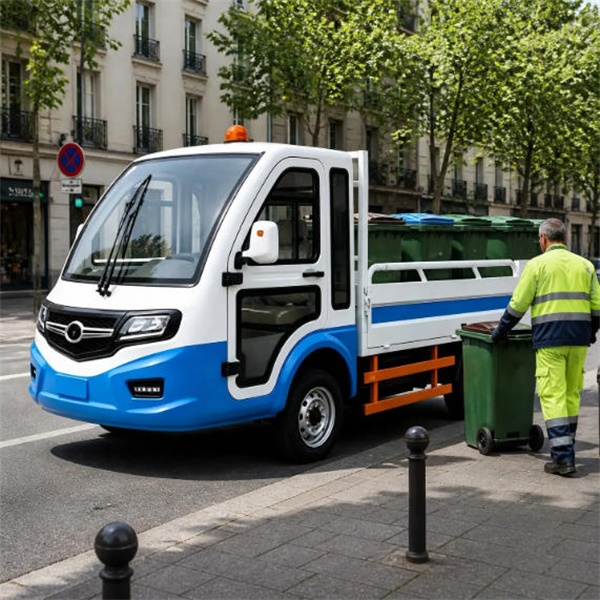
When people hear “waste truck,” they usually picture a large rear-loading compactor with a hydraulic packer and a crew hanging off the back. That image fits municipal bulk collection, but it is only one type. Lots of waste collection happens on a smaller scale: scattered bins along narrow lanes, residential compounds, markets and pedestrian zones, where full-size compactors cannot pass easily. This guide focuses on compact electric collection vehicles. We use an 8-bin electric model to explain its functions and operational limits.
Where Small Collection Vehicles Fit
This electric four-wheeled machine is built to collect and transport scattered 240L waste bins. Its carriage holds eight standard 240L bins. It works as a bin carrier — it moves filled bins to transfer stations, instead of crushing waste to cut volume.
This difference defines its usage. A waste compactor truck squeezes waste hydraulically, so one trip can carry much more waste. A bin carrier has fixed capacity based on how many bins it can load. Its main advantage is maneuverability. At 4,350 mm long with a 5 m minimum turning radius, it accesses tight zones without blocking narrow roads for long periods.
Three common terms overlap but serve different purposes: waste management truck, waste collection truck, waste compactor truck. This vehicle falls into the light-duty, short-range waste collection category.
Electric Drive and the Daily Route
It uses a 72V 5.5kW motor paired with a 72V 200A maintenance-free battery. It delivers 80 km driving range, with 6–8 hours charging time from 80% discharge. This suits fixed short routes inside compounds, markets and campuses. For longer routes, charging time becomes the main scheduling limitation.
The control system adopts high-frequency PWM chopper technology. Built-in safety functions include start delay, back-up deceleration and speed limiting. These reduce risks in crowded, frequently reversing working zones. Its resistance-type accelerator features low failure rates, cutting unexpected downtime.
Top speed is 30 km/h and gradeability reaches 10%. These figures confirm it is designed for stop-start on-site collection, not high-speed road transport.
Hydraulic Tail Plate and Bin Handling
The hydraulic tail plate is its most practical feature, controlled by four cylinders for lifting, lowering, opening and closing. A full 240L bin can weigh over 50 kg. Manual repeated lifting causes strain injuries. The tail plate lets operators roll bins onto the platform and lift mechanically.
Full-load lifting takes 6 seconds, with a 500 kg lifting rating. When calculating load limits, you need to add the weight of 8 filled bins, operator and onboard components together, to avoid overloading the vehicle.
The carriage floor uses anti-slip checkered steel plate to stop bins sliding during turns. Shifting bins can damage the carriage, bins or hydraulic tail plate structure.
Chassis and Stability
The chassis adopts automotive-style construction with integrated front and rear axles. Dual-circuit hydraulic brakes with vacuum assist offer reliable stopping power. Loaded bin carriers have a high center of gravity and often face sudden stops around pedestrians, so stable braking is critical.
It is fitted with 8-layer radial heavy-load vacuum tires for wear resistance. Low speed plus heavy load puts high demands on tires, which also affect rolling resistance and battery range. Its 140 mm ground clearance works well on paved ground but limits off-road use.
The cab is built with corrosion-resistant high-strength fiberglass, resisting leachate and humid waste-site corrosion. The bin carriage is welded steel, so its anti-corrosion performance relies on paint coating and regular maintenance.
Hidden Spec Limitations
The official datasheet lists dimensions, motor, battery and chassis parts, but misses key data that decide total ownership cost. It does not state fully loaded payload, battery cycle life or hydraulic service intervals. Confirm these details directly with suppliers instead of guessing from headline parameters.
It also does not clarify whether the 10% gradeability rating applies under full load. For sites with ramps or sloped access, you need to verify this before deployment.
A Vehicle Defined by Route, Not Capacity
Waste trucks cover a wide range, from compact electric bin carriers to heavy compactors. This small model’s strength is access, not large volume. It reaches narrow zones that big trucks cannot enter, runs quietly in residential areas and reduces manual lifting work. It works perfectly within these boundaries. It is not suitable for long-distance routes, high-volume collection or rough unpaved ground.
Frequently Asked Questions
When should I choose a bin carrier instead of a compactor truck?
Pick a bin carrier for narrow lanes, pedestrian zones, small compounds and scattered low-volume bins. If you have high daily waste volume and wide access roads, a compactor truck delivers much better efficiency.
What common risks come with electric bin collection vehicles?
Main risks include overloading the carriage, battery degradation with frequent deep discharge, loss of braking performance on slippery ground, and hydraulic cylinder leakage on the tail plate under repeated lifting cycles.
What are typical hydraulic tail plate faults on bin carriers?
Common issues are slow lifting, uneven movement, oil leakage from cylinder seals and failure to lock in position. Regular hydraulic oil inspection can prevent sudden breakdown during bin loading.
How do I verify whether this truck can safely climb my site ramp?
Confirm the gradeability rating applies under full loaded condition. Calculate total weight including bins, operator and onboard equipment. Test on-site if the ramp is close to the rated 10% slope.
What maintenance does an electric bin carrier require?
Check batteries, brake systems, hydraulic circuits and tire wear regularly. Inspect tail plate cylinders. The electric drivetrain has fewer wear parts than diesel models, but hydraulic and brake systems still need scheduled service.
Post time: Nov-04-2026