

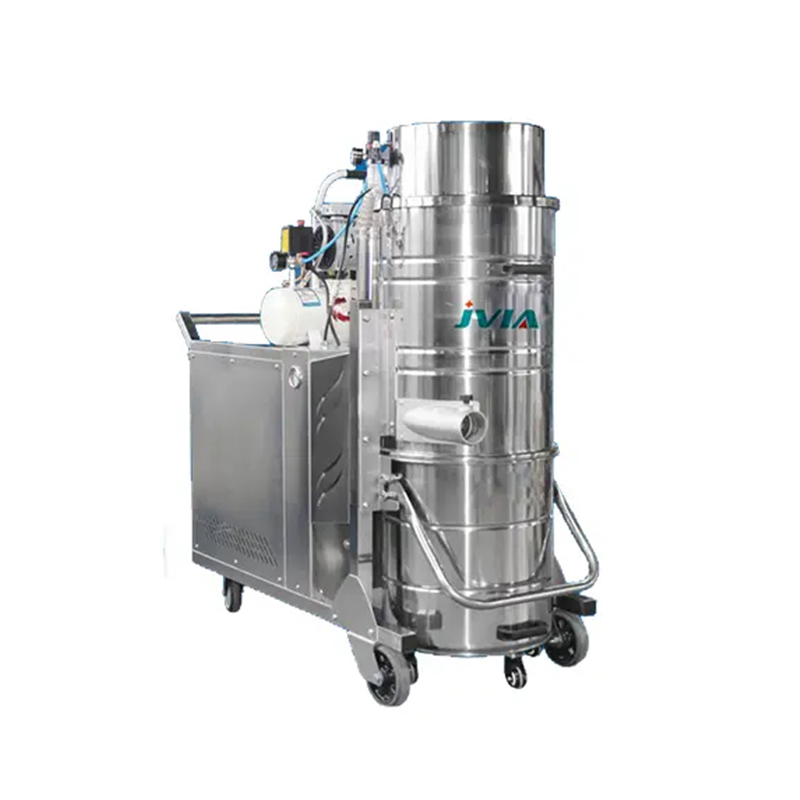
Industrial vacuum cleaners collect dust, debris, and liquids continuously across shifts in factories, warehouses, and processing plants. They differ from shop vacuums in motor durability, filtration quality, and capacity. A standard wet-dry vac suits occasional cleanup. An industrial unit runs for hours daily, captures fine powders that pass through paper filters, and handles metal shavings to food powders without clogging or burning out under sustained use.
Key Differences That Set Industrial Units Apart
The motor design reveals a lot. Industrial vacuum cleaners typically use bypass-cooled motors where working air and cooling air travel separate paths, keeping dust away from the motor windings. Single-stage motors handle light debris. Multi-stage turbine motors produce the sustained suction and water lift needed for heavy materials, long hose runs, or central piping networks across a production floor.
Filtration marks the second key difference. A basic cloth or paper bag cannot trap fine respirable dust from sanding, grinding, or powder handling. Industrial units rely on surface-filtering cartridges or pocket filters that capture particles well below visible range. Many carry H-class or M-class filtration ratings under dust extraction standards, which matters for compliance with silica, wood dust, or chemical powders. Automated filter cleaning reverse air pulses or mechanical shakers maintains suction without stopping for manual filter knocking.
Construction materials reflect the heavier duty cycle. Thicker steel or heavy-gauge plastic tanks, reinforced hose connections, and castors rated for floor loads rather than occasional garage use all point to equipment built for daily industrial service.
Where Industrial Vacuum Cleaners Do the Heavy Lifting
The range of tasks these machines take on is broad, but a few applications show up regularly:
- Manufacturing and assembly lines: Continuous collection of metal chips, plastic trim, and fasteners around machining centers and conveyor belts that run across three shifts.
- Food processing plants: Recovery of flour, sugar dust, grain spills, and liquid residues in washdown areas, often with stainless steel construction and smooth surfaces that prevent bacterial harborage.
- Pharmaceutical and chemical facilities: Capture of active powders and dusts where cross-contamination between batches is a serious concern, typically with sealed filter systems and safe-change bag-in bag-out options.
- Woodworking shops and furniture factories: Managing large volumes of sawdust and sanding dust that can build to combustible concentrations if left to settle on beams and ledges.
- Warehouse and distribution centers: Cleaning loading docks, racking aisles, and conveyor systems where debris accumulates faster than manual sweeping can keep up.
- Construction and renovation: Collecting concrete dust, drywall compound, and mixed demolition debris using units that can be wheeled from floor to floor and run on the available site power.
The common requirement in every case is sustained performance. An industrial vacuum cleaner that loses suction halfway through a shift because the filter is clogged or the tank is full creates a bottleneck. The cleaning schedule starts to slip, and the debris builds up in places where it causes quality problems or safety hazards.
What to Look for When Choosing a Unit
Matching the machine to the material prevents most of the complaints that surface after installation. A few practical checks narrow the field:
- Dust type and filtration requirement: Is the dust simply a nuisance, or is it classified as hazardous? The answer determines whether a standard cartridge filter is enough or whether HEPA-grade filtration and sealed recovery bags are necessary.
- Collection capacity and emptying method: A small tank that fills in twenty minutes disrupts workflow. Bins that roll away, lift-out containers, or continuous discharge options keep the cleaner running. For wet collection, a drain valve at the base saves tipping heavy liquid loads.
- Power availability and phase: Single-phase units plug into standard wall sockets. Three-phase motors deliver higher power and continuous duty ratings but need an appropriate supply. Battery-powered industrial units are appearing for light debris in areas without convenient power drops.
- Hose diameter and tool compatibility: A wide hose handles bulky debris and reduces clogging. Narrower hoses generate higher air velocity for fine dust extraction at the tool connection point. The choice depends on whether the cleaner connects directly to a production machine or serves as a general floor-cleaning tool.
- Noise level and location: An open warehouse may tolerate high decibel output. A unit stationed near assembly workers or in a clean room will need a sound-insulated motor housing or a remote turbine configuration.
Installation That Makes Daily Use Easier
Positioning an industrial vacuum cleaner close to the debris source cuts hose length and keeps suction losses low. If the unit connects to a fixed pipe network, the piping diameter, radius of bends, and the number of Y-junctions all affect the airflow at the furthest drop point. Bringing the vacuum closer to the work zone and using smooth-bore pipe instead of flexible hose where possible reduces air resistance noticeably.
A dedicated power isolator within reach of the unit simplifies lockout during emptying and filter changes. For wet collection tasks, a float shut-off mechanism prevents the tank from overfilling and sending liquid into the turbine, but that float should be checked and cleaned regularly because sticky residues can hold it open.
Upkeep That Keeps Suction Steady
Filter maintenance makes the biggest difference to long-term performance. A filter caked with fine dust increases motor load and drops airflow. Pulse-cleaned filters still need eventual replacement because fine particles work into the filter media and cannot be dislodged by the reverse air pulse. Checking the pulse pressure and solenoid valve function as part of scheduled maintenance keeps the cleaning cycle effective.
Hoses and seals should be inspected for cracks and vacuum leaks. Even a small tear in a hose or a missing O-ring at a tool connection lets unfiltered air into the system, reducing the capture velocity at the pickup point. The motor cooling air intake on bypass-cooled machines needs to stay free of dust buildup, or the motor temperature climbs and the thermal cutout trips at the least convenient time.
A Piece of Site Infrastructure That Earns Its Floor Space
Industrial vacuum cleaners rarely get attention until one is missing. Dust settles on products, walkways become slip hazards, and debris clogs machine sensors all signs of housekeeping that fell behind. Choosing a unit built for continuous duty, filtered to match the dust type, and maintained on a simple schedule stops cleaning from becoming the bottleneck. When a factory floor stays cleaner with less effort, the vacuum has done its job.
Post time: May-11-2026