

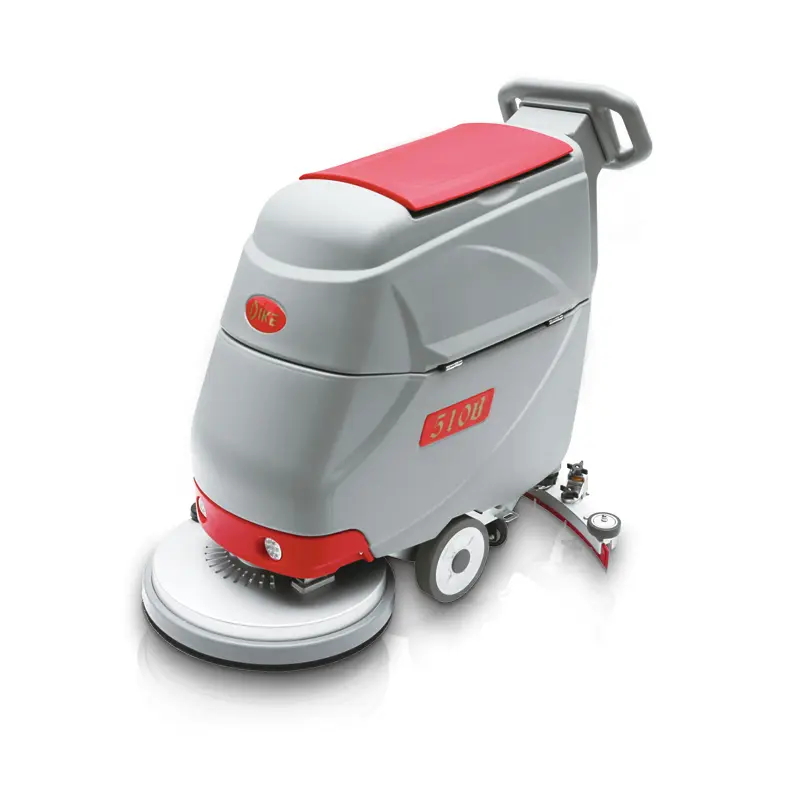
A walk-behind floor scrubber is a powered machine that scrubs and dries hard floors in one pass. It dispenses clean water and cleaning solution, rotates a brush or pad against the floor, and immediately vacuums the dirty slurry into a recovery tank. The floor comes out clean and nearly dry, ready to walk on within minutes. For warehouses, retail stores, schools, and hospitals, it replaces the mop and bucket with something far faster and more consistent.
Why it outperforms manual mopping
Mopping spreads dirty water around. Even with frequent bucket changes, the mop head pushes soiled solution into grout lines and surface pores. A walk-behind floor scrubber avoids this entirely by keeping fresh solution and recovered wastewater separate. That means the machine always scrubs with clean water, never re-depositing grime.
The productivity gap is hard to ignore. An operator with a mop might cover 3,000 square feet per hour. A walk-behind floor scrubber handles 15,000 to 30,000 square feet in the same time. It also applies steady down pressure that human arms simply cannot match over a full shift. The outcome is a deeper, more uniform clean and a floor that dries quickly, cutting slip risks in busy corridors.
Choosing the right scrubber type for your floors
Not all scrubbers suit every surface. Matching the machine to the floor prevents damage and improves results.
●Disc scrubbers spin a round pad at moderate speed, best for smooth, sealed surfaces like vinyl, polished concrete, terrazzo, and epoxy. Pads swap easily for scrubbing, buffing, or stripping, offering extra flexibility.
●Cylindrical scrubbers use counter-rotating tube brushes that sweep and scrub in one pass. They handle textured safety flooring, grouted tile, uneven concrete, and ramps well, and the brushes pick up small debris often eliminating the need to pre-sweep.
●Orbital scrubbers oscillate a rectangular head at high frequency like hand scrubbing. Quieter and gentler on delicate surfaces, they’re a popular choice for retail spaces cleaned during business hours.
Cylindrical scrubbers cover the most ground in buildings with mixed surfaces like vinyl, tile, and concrete without changing brushes. For all-smooth floors with occasional burnishing needs, a disc scrubber offers extra value beyond daily cleaning.
Key specifications to evaluate
Every floor plan presents different challenges. A few numbers determine whether a walk-behind floor scrubber will work well in a specific building.
●Cleaning path width:Wider decks cover more floor per pass but struggle in narrow aisles. Measure the tightest space the machine must navigate. A 20-inch deck in a 24-inch aisle leaves little turning room and risks scraping walls or shelving.
●Tank capacities:Solution and recovery tank sizes determine how long the machine runs between stops. Larger tanks reduce interruptions but add weight when full. Balance run time against the operator’s ability to push the machine on inclines.
●Battery type and run time:Corded models limit reach and create trip hazards. Most commercial scrubbers use batteries. Flooded lead-acid costs less upfront but needs watering and equalization charges. Lithium-ion charges faster, lasts longer per shift, maintains steady voltage, and weighs less overall.
●Down pressure:Scuffs and compacted dirt need more than the brush’s own weight. Adjustable down pressure lets the operator increase force on heavy soil and ease off during maintenance cleaning. Higher pressure often means fewer passes.
●Sound level:A scrubber running at 65 dB won’t disturb customers or office workers. One pushing 75 dB might draw complaints during operating hours. If daytime cleaning matters, check the decibel rating before ordering.
Routine care that extends the machine’s life
A walk-behind floor scrubber has pumps, vacuum motors, brushes, and squeegees. A few simple end-of-shift habits keep it running reliably.
Drain and rinse the recovery tank daily. Dirty water left overnight breeds odors and sludge that clog filters and vacuum lines. Wipe the squeegee blades clean and check for rounding worn blades leave streaks and force extra passes. Flip or replace them when water pickup drops.
Brushes and pads are consumables. A worn brush loses effectiveness and can leave haze on the floor. Keep spares on the shelf. Battery care depends on chemistry: lead-acid needs periodic watering and should never be fully discharged; lithium packs are mostly maintenance-free but should be plugged in at shift end rather than run to empty.
Walk-behind versus ride-on: which makes sense
For spaces up to about 50,000 square feet per shift, a walk-behind floor scrubber usually hits the sweet spot. It costs less upfront than a ride-on, fits into tighter areas, and stores in a smaller footprint. Ride-on models cover open ground faster but struggle with tight turns, doorways, and confined rooms.
Total square footage isn’t everything layout matters more. A school with separate classrooms, narrow hallways, and no freight elevator often finds a walk-behind scrubber far more practical than a ride-on that cannot fit through doors or move easily between floors.
Questions to work through before purchasing
A structured look at the facility prevents the wrong purchase. Before comparing models, collect a few details.
●Floor surface and condition:Sealed, textured, polished, or coated? The answer narrows the scrubber type immediately.
●Aisle widths and tight spots:The most constrained space in the building sets the maximum deck width.
●Cleaning schedule:Daytime cleaning favors quieter, slower-discharge orbital or cylindrical machines. Overnight cleaning opens up more options on noise and pad type.
●Solution handling:Some scrubbers auto-mix chemical from a cartridge; others need pre-mixed solution. Auto-mixing reduces chemical waste and guesswork but adds upfront cost.
●Service access:Every scrubber eventually needs squeegee blades, brushes, vacuum motors, or control boards. Verify local parts availability and service access upfront. The lowest online price means nothing if a simple repair keeps the machine down for weeks.
What changes after the switch
Switching from a mop to a walk-behind floor scrubber saves more than time. Floors dry faster because the vacuum extracts most of the water, and consistency improves every section gets the same pressure and brush dwell time. Over months, finishes hold up better and require less stripping and recoating.
For buyers and facility managers, the machine works best when it fits the daily routine instead of forcing changes. Matching the scrubber to the building’s actual conditions floor type, layout, operator availability, and service support creates a tool that earns its place every shift. A well-chosen unit quietly handles the heavy lifting until the day it isn’t there and the cleaning team feels the difference immediately.
Post time: May-16-2026